

When customer, product, inventory, sales and financial information live in disconnected systems, teams spend time reconstructing different versions of the same activity.
Connected systems reduce repeated transfer and make it easier to understand how one operational event affects another.
Connection creates operational context.
Customers and transactions
Commercial activity remains connected to the customer relationship and its history.
Products and inventory
Demand, availability and fulfilment can be understood within the same operating picture.
Sales and finance
Transactions can flow into the appropriate financial and reporting processes.
Activity and visibility
Operational events support timely decisions instead of delayed manual reconstruction.
Connected Operations: The Unseen Architecture of Intelligence
Imagine a business as a living organism. Its heartbeat is the flow of customer orders, its circulatory system is the movement of inventory, its nervous system is the transmission of financial signals, and its memory is the accumulated history of every interaction. When these systems are disconnected, the organism suffers from a kind of organisational sclerosis. Each part functions, but they function in isolation, unable to sense what the others are doing, unable to respond with speed or coherence. Connected operations restore the organism to health by ensuring that every part knows what the others know, and every action is understood in the context of the whole.
Connection is not a technical achievement; it is a philosophical commitment. It is the belief that a business is greater than the sum of its silos, and that the value of information multiplies when it is shared, not diminished. When customer, product, inventory, sales, and financial information live in separate systems, teams are forced into a cycle of reconstruction. They spend their days reconciling contradictions, guessing at missing context, and manually stitching together fragments that should never have been separated. This is not merely inefficient; it is a fundamental failure of design. It forces people to act as translators between machines, a role that adds no value and consumes the very time that should be spent on strategic thinking, creativity, and customer care.
Connected operations eliminate this friction. They make it possible to see how one operational event affects another, not in hindsight, but in real time. A surge in customer demand becomes visible not only to sales, but also to inventory, logistics, and finance. A delay in supply chain is felt immediately across fulfilment and customer service. A pricing change is reflected instantly in financial forecasts. This is the power of connection: it turns isolated events into shared intelligence, and shared intelligence into faster, wiser action.
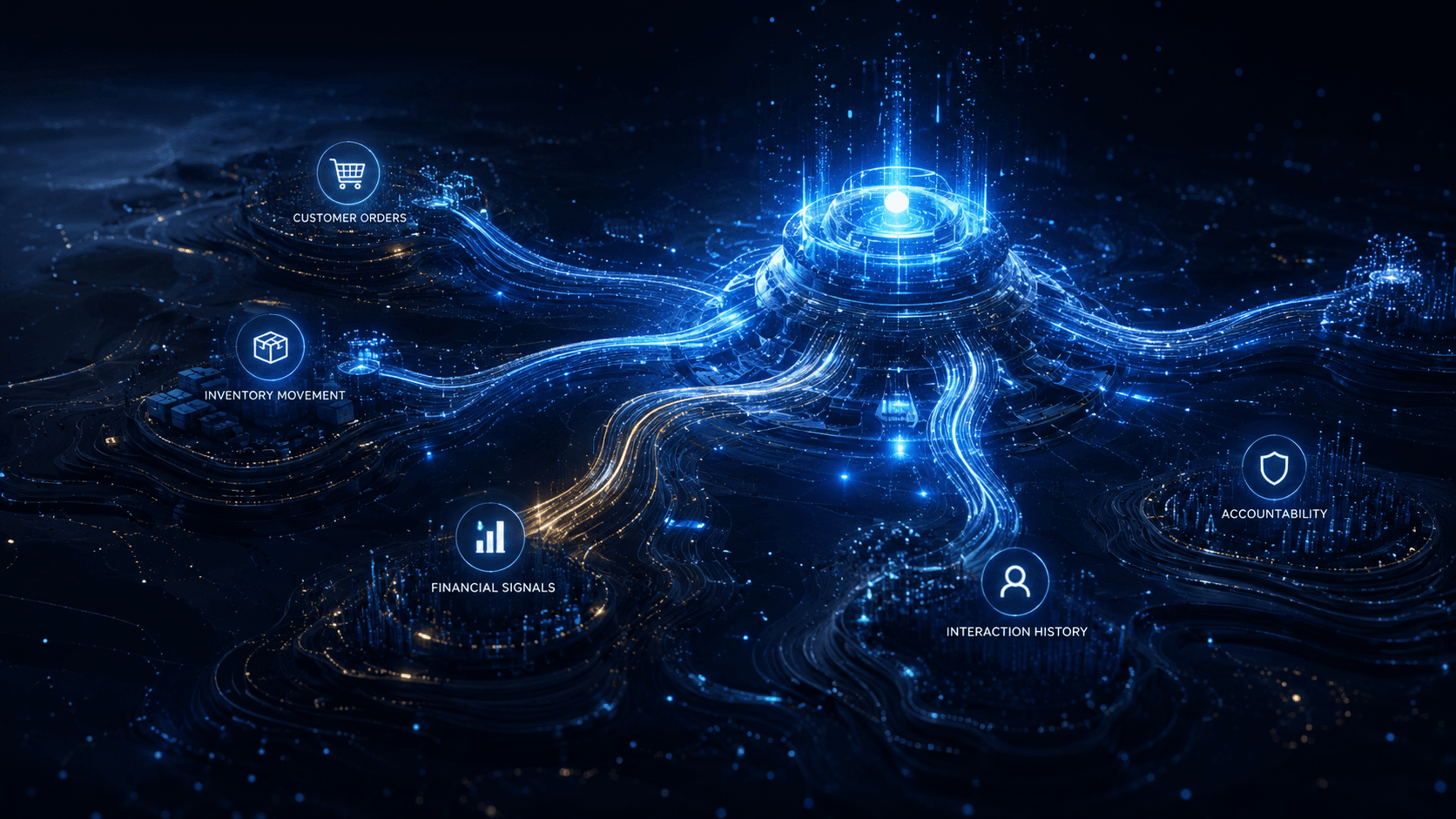
Relationships deliberately designed and continuously maintained.
Connection is not a single action; it is a constellation of relationships that must be deliberately designed and continuously maintained. These five pillars form the foundation of any connected operating model.
The Customer Continuum
Every transaction is a chapter in an ongoing story. To treat a sale as an isolated event is to ignore the history that gives it meaning.
Connection means that every commercial interaction, whether a purchase, an inquiry, a complaint, or a return, is anchored to the full customer relationship.
This continuity allows teams to recognise patterns, anticipate needs, and personalise responses. It transforms the customer from a data point into a partner, and it ensures that the business remembers what matters, even when the customer does not have to repeat themselves.
The Inventory Nervous System
Demand, availability, and fulfilment are not separate concerns; they are three dimensions of the same operational reality.
When these are disconnected, inventory becomes either a source of cost or a source of customer frustration.
Connection creates a unified operating picture where every item is visible, every location is known, and every movement is tracked.
This visibility enables proactive decision making, where shortages are anticipated, surpluses are redeployed, and fulfilment becomes a seamless expression of supply meeting demand.
The Financial Thread
Sales and finance are often treated as sequential functions, where transactions are passed from one to the other like a baton in a relay race.
This handoff creates delays, errors, and opportunities for misalignment.
Connection weaves a continuous financial thread through every transaction, ensuring that commercial activity flows directly into appropriate financial and reporting processes.
This eliminates the reconciliation gap and provides real-time visibility into profitability, cash flow, and performance. It turns finance from a backward-looking scorekeeper into a forward-looking strategic partner.
Operational Visibility
The ultimate purpose of connection is to enable timely decisions.
When operational events are visible in real time, they support action instead of requiring reconstruction.
This visibility is not about overwhelming people with data; it is about surfacing the right information at the right moment, in a format that enables judgment.
It transforms decision making from a reactive exercise, where leaders respond to problems after they have occurred, into a proactive discipline, where they anticipate, adjust, and optimise continuously.
Accountability Anchored to Action
Connection preserves the link between information and accountable people.
It is not enough to know what happened; we must know who is responsible for responding.
Connected systems make this link visible, ensuring that every action has an owner, every decision has a context, and every outcome has a point of accountability.
This is the human dimension of connection, the recognition that technology exists to serve people, not to obscure them.
A business that senses, responds, and grows as one coherent entity.
Connected operations are not a destination; they are a discipline. They require continuous attention to the relationships that matter, the flows that must be maintained, and the people who depend on the system. The payoff is not merely efficiency, although efficiency is a natural byproduct. The true payoff is a business that learns, adapts, and grows as a single, coherent entity.
When connection is done well, the business becomes something more than the sum of its parts. It becomes a system that understands itself, that can sense and respond to change, and that can act with the speed and wisdom of a unified mind. Customers feel this connection in the seamlessness of their experience. Employees feel it in the clarity of their work. Leaders feel it in the confidence of their decisions.
This is the ultimate promise of connected operations: not simply a business that runs better, but a business that thinks better, because every part of it is in conversation with every other part, and every decision is grounded in the full reality of what is happening, what has happened, and what is possible next.